 By
By
Combined chlorine is chlorine in water that has reacted with and bound to nitrogen compounds. These reactions create chloramine byproducts like monochloramine, dichloramine, and the noxious trichloramine that off-gasses and causes coughing for swimmers, and corrosion for natatoriums.
This article expands on our previous article about the science of chlorination.
Covered in this article:
Combined chlorine (the most known variants are called chloramines) is chlorine that has combined with nitrogen compounds in water.
No nitrogen in the water ⇔ No combined chlorine
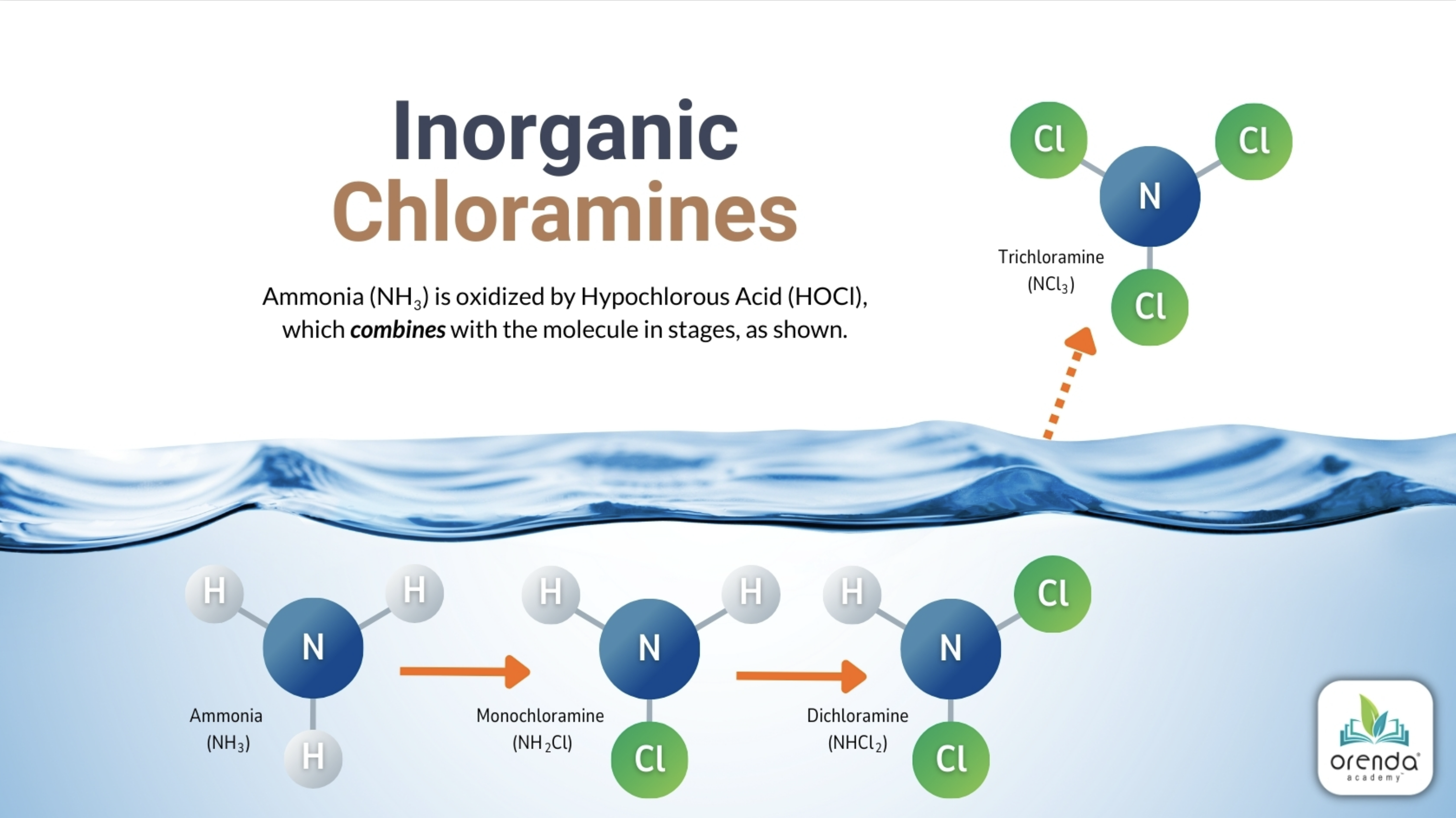
The illustration below shows how chlorine combines with ammonia via substitution reactions, because at the chlorine levels used in swimming pools, chlorine is not strong enough of an oxidizer to destroy ammonia on its own.
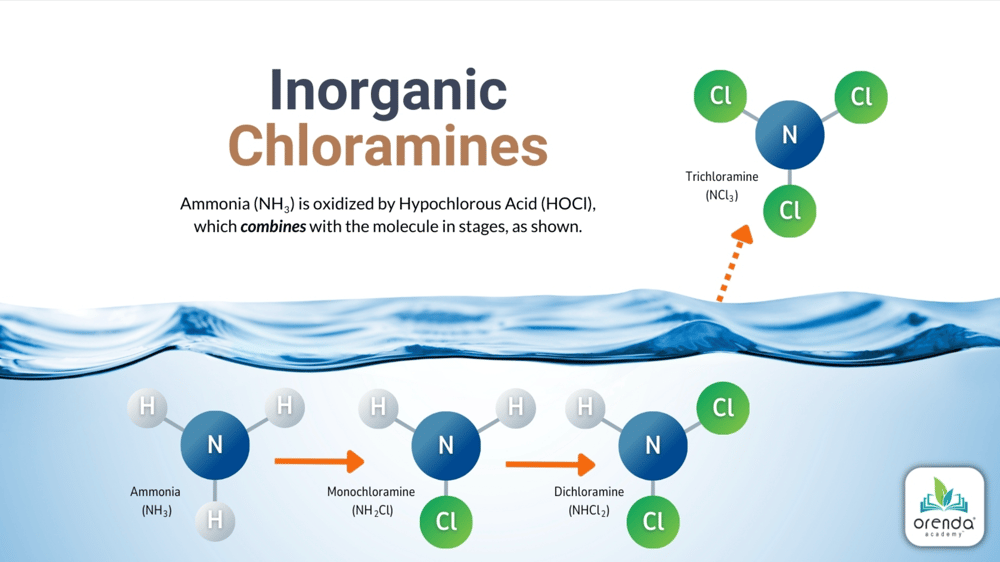
Chloride ions substitute Hydrogen as more and more Hypochlorous acid (HOCl) oxidizes inorganic ammonia. Credit: Orenda Technologies / HASA, Inc. Used with Permission.
When chlorine finally finishes off ammonia and other nitrogen compounds, the final products are Nitrogen gas (N2) and nitrates.1
Related: Pool Chemistry Resources
Total Chlorine Higher than Free Chlorine?
Chlorine is present in water in three forms:
-
Free available chlorine (FAC or FC). Available to sanitize and oxidize contaminants. The active, killing form of chlorine is hypochlorous acid (HOCl).
-
Combined chlorine (CC). Chlorine that has already reacted with nitrogen compounds. It forms chloramines and other byproducts that carry some disinfection ability, but weaker and slower than HOCl.
- Total available chlorine (TAC). The sum of free and combined chlorine together.
TAC - FAC = CC
TAC - CC = FAC
FAC + CC = TAC
So if your Total Chlorine is higher than your free chlorine, it simply means your total chlorine test is picking up chlorine that has already combined with nitrogen compounds. Ideally this value is zero, meaning all your chlorine is free and available to kill pathogens quickly.
Related: Types of Pool Chlorine
How to Test for Combined Chlorine
There are no test kits that directly measure combined chlorine. Instead, you must test for both free and total chlorine. Most pool test kits can do this (DPD testing).
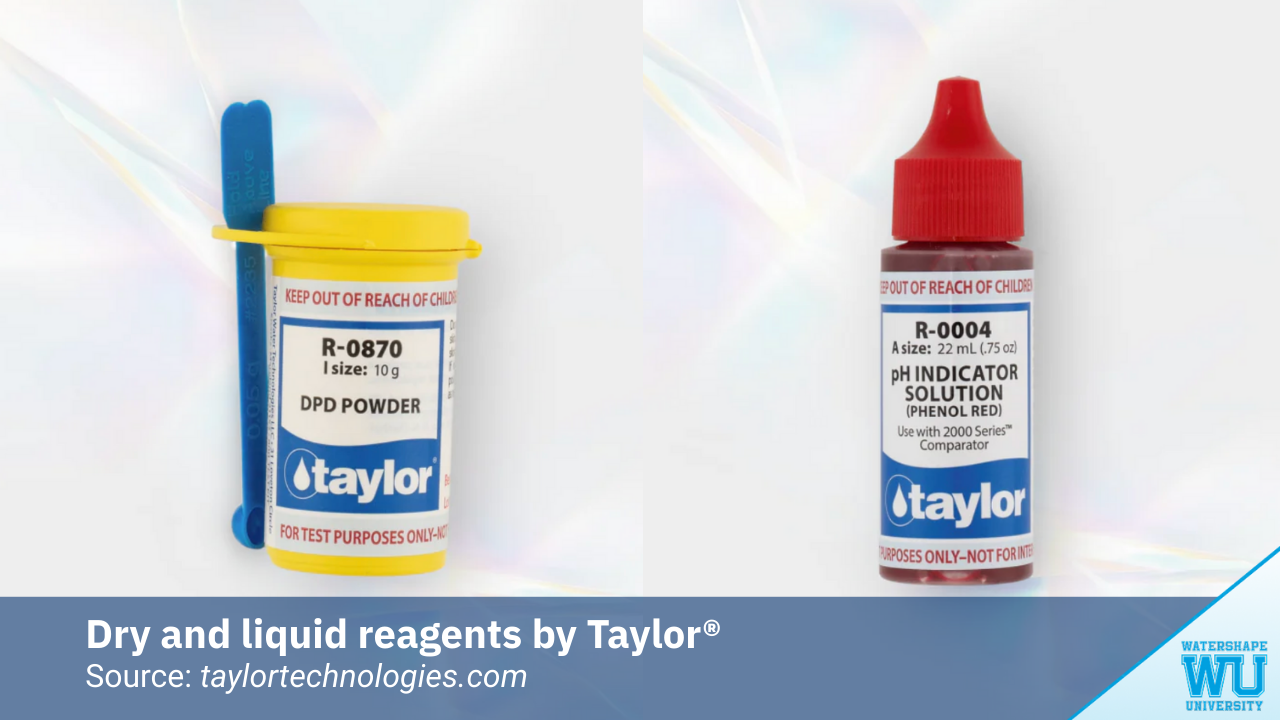

Examples of test kits that can measure both free and total chlorine levels. Images courtesy of the manufacturers for Watershape University®, used with permission.
Using the three equivalent formulas above, you can calculate combined chlorine by simply subtracting free chlorine from total chlorine.
If your total chlorine level is higher than your free chlorine, that gap is combined chlorine, and it proves you have (or at least had) nitrogen in the water.
There are automated controller systems that have free chlorine and total chlorine probes that allow operators to see combined chlorine in real time. These systems are highly valuable to pool operators, especially if integrated with a source-capture exhaust system.
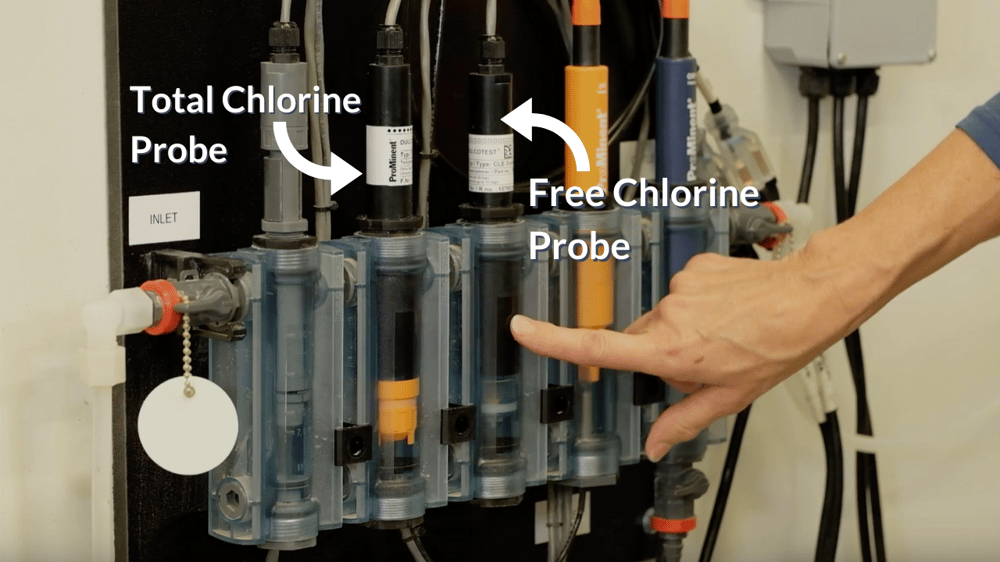
There is no combined chlorine meter (at least, as of the time we published this article). But free and total chlorine probes allow it to be calculated by a chemical controller.
This real-time combined chlorine reading is a reliable way to track bather load, as all bathers introduce at least some nitrogen and organics into the water. This is partly why it is recommended that swimmers rinse off in the shower before getting in the pool. A larger contributor than sweat is urine. Swimmers pee in pools regularly, even though it's disgusting. It's a part of the swimming culture, and that culture would have to change before the problem will go away.
What Causes High Combined Chlorine?
In our opinion, anything above 0.2 ppm is high. Above 0.5 ppm is very high, and may violate local health codes. Extremely high levels like 1.0 or higher are almost always caused by a chemical conflict, not just swimmer waste. We have seen combined chlorine over 10 ppm before. At that point, we know there's a chemical conflict. It's almost always ammonia-based algaecides and/or floor cleaning chemicals being tracked into the pool. Evaluating such chemicals is one of the many things we do in our in-person facility evaluations.
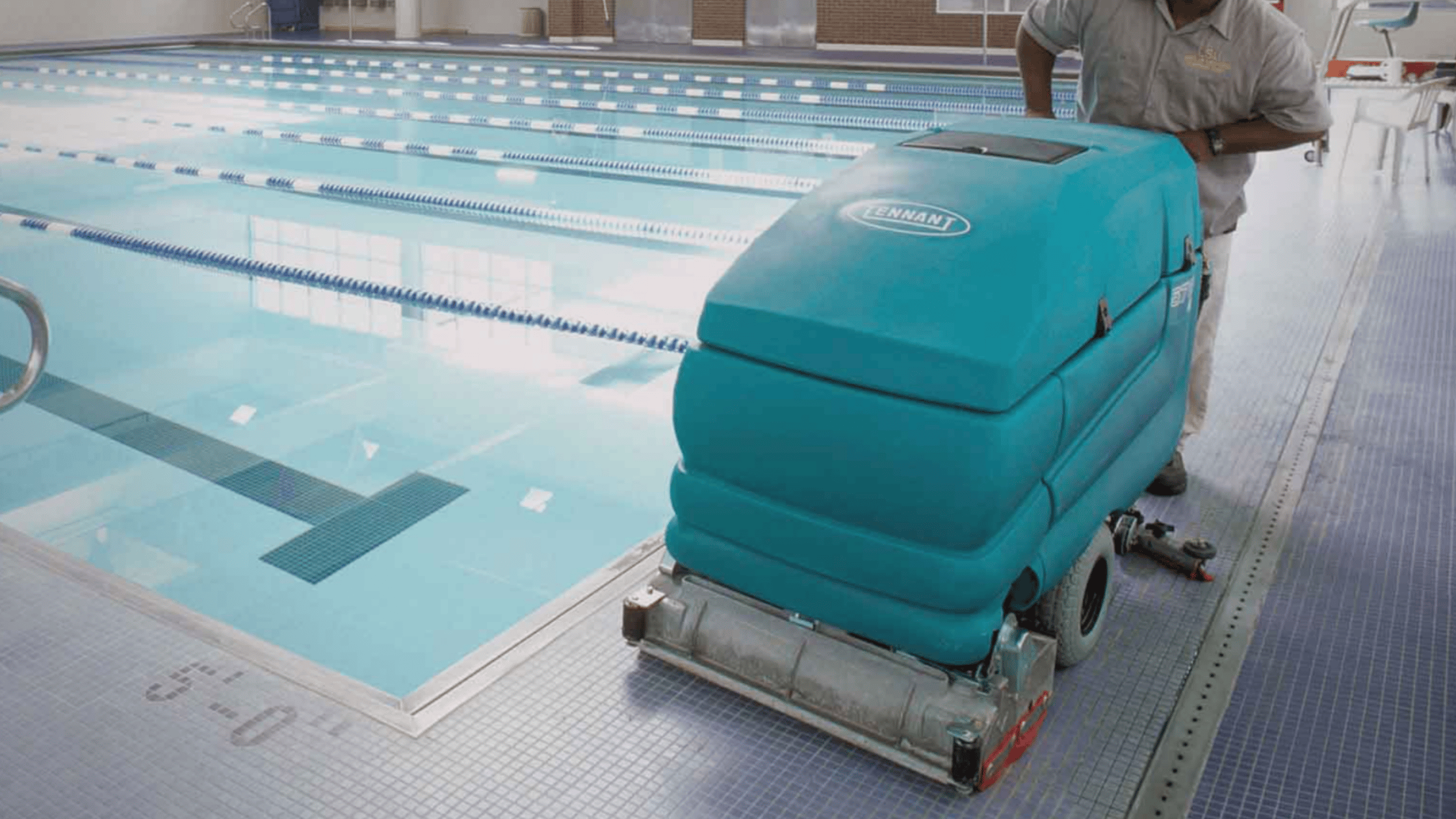
We have been hired to help hundreds of aquatic facilities that struggled with high combined chlorine over 0.5 ppm. In each case, we helped modify their HVAC system and duct design, and air quality improved dramatically. As for the water, addressing combined chlorine is simpler than you might think.
The clients we're referring to did not need radical changes in their system to correct their chemistry. They just needed to think differently and swap some chemicals out for more compatible ones. This often includes exchanging deck cleaning chemicals for sodium hypochlorite-based cleaners, abandoning algaecides, and implementing a regiment of enzymes to break down organic compounds into simpler inorganic compounds.
Organic Chloramines vs. Inorganic Chloramines
The graphic shown earlier shows the process of chlorine combining with inorganic ammonia (NH3). There is no carbon in it, so it is considered inorganic. When carbon is part of the compound, it becomes organic, and the chemistry becomes more complex.
It already takes a lot of chlorine to get rid of ammonia, so you can imagine how much more chlorine would be required to break down an organic nitrogen compound like urea:
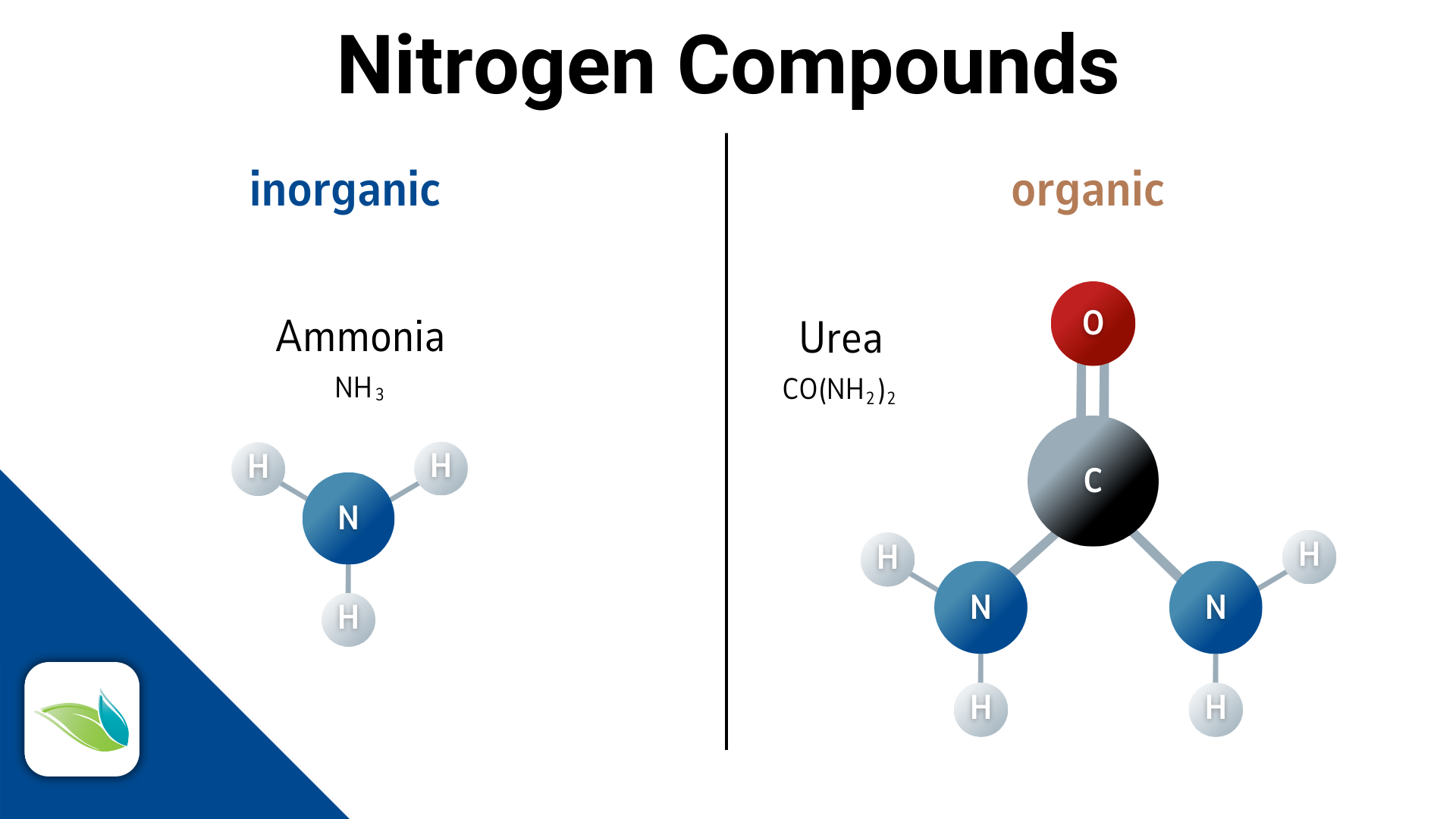
Graphic: Illustration of a molecule of ammonia (inorganic nitrogen compound) compared to urea (organic nitrogen compound). Credit: Orenda Technologies / HASA, Inc. Used with permission.
Achieving breakpoint chlorination with organic nitrogen leaves behind significantly more varieties of harmful byproducts. Below is just a glimpse of the reactions that take place for chlorine to remove urea from water. Every step of the way consumes more chlorine and creates more harmful byproducts:
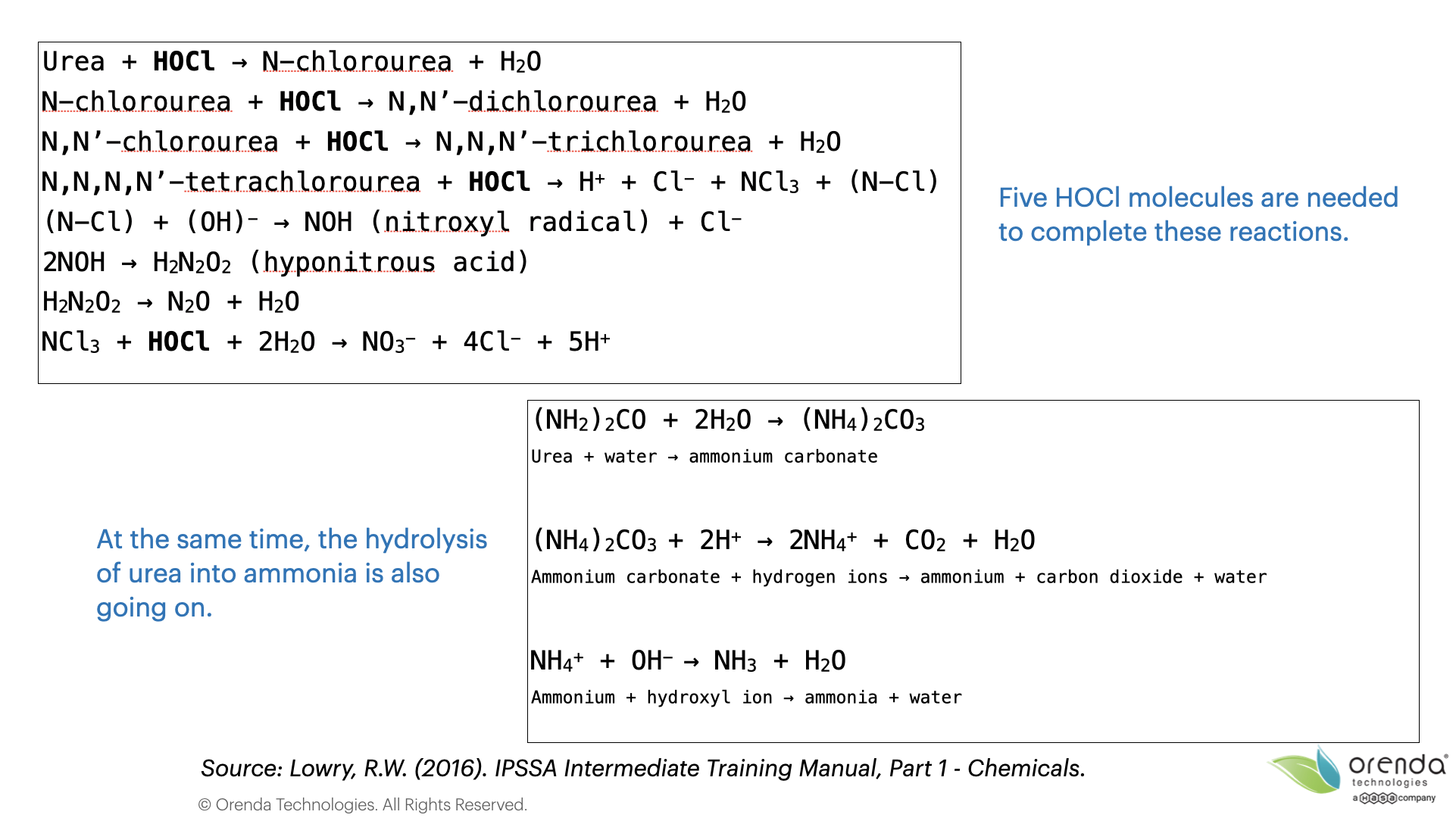
Graphic: Screenshot from an Orenda® presentation on chemical conflicts. Original source: Lowry, Robert W.(2016). IPSSA Intermediate Training Manual, Part 1 - Chemicals. Used here with permission from Orenda / HASA, Inc.
The Case Against Algaecides
Most algaecides contain complex nitrogen-based ingredients. These products leave behind unwanted byproducts in the water and contribute to combined chlorine in a major way.
The more complex the nitrogen compound, the more chlorine consumed, and the more byproducts produced. Many of these byproducts are known to be harmful. The pool industry uses the term "chloramines" generically to describe all of them, but in reality, there are hundreds upon hundreds of possible byproducts created.
And if you thought Urea was complicated...how much more complex are some of the algaecides sold in the pool industry?
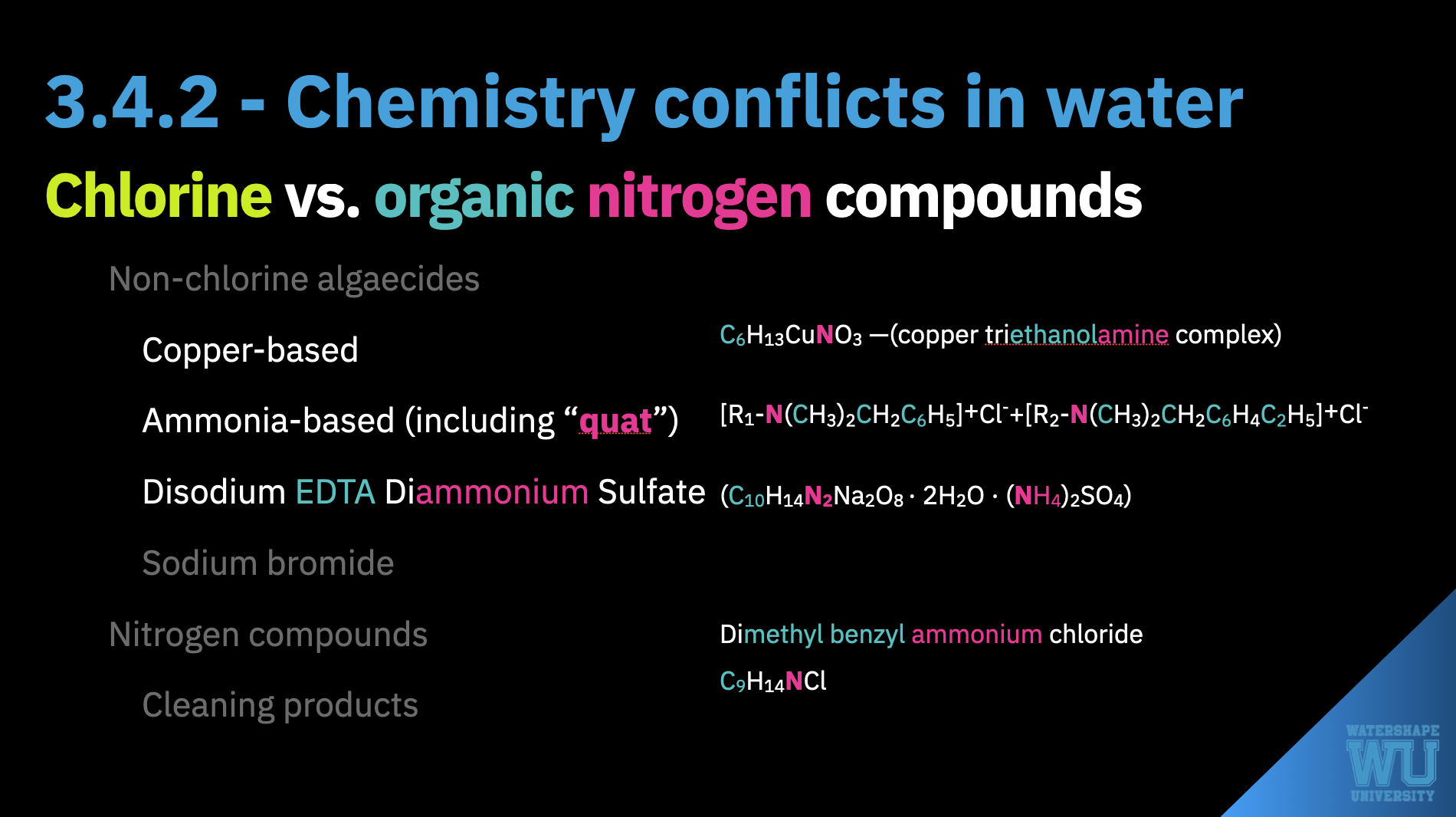
Graphic: Screenshot of a Watershape University® class (Service 2211: Essential Water Chemistry), showing the chemical formulas of common pool algaecide products and their active ingredients. Pink represents nitrogen-based substances, and turquoise represents carbon-based (organic) substances. As you can see, these algaecides are highly complex (moreso than urea!). What byproducts do you think will be lurking in your water after using them? Credit: Watershape University®. Used with Permission.
We strongly advise against using algaecide products in swimming pools. Not because they don't kill algae...but because of the harmful long-term byproducts they leave behind in the water.
Combined Chlorine FAQs
Below are answers to the most common questions we get about combined chlorine.
What is the maximum acceptable level of combined chlorine?
How much combined chlorine is acceptable? At what point is it a problem? When do swimmers and lifeguards begin noticing it and feeling discomfort?
Most health departments in the United States limit combined chlorine to 0.2 or 0.5 ppm. At 0.5 ppm, pools can be shut down, depending the local health code. Anecdotally, people tend to notice irritation around 0.2 ppm. At 0.5 ppm, pretty much everyone is experiencing irritation.
Of course, the ideal combined chlorine level is zero (0 ppm). As far as indoor air quality is concerned, combined chlorine is the closest measurement we have for knowing the rate and severity of airborne chloramine production.
↑combined chlorine = ↓indoor air quality
Total chlorine keeps rising, but free chlorine doesn't. Why?
A rising TAC and a relatively flat (or dropping) FAC indicates the chlorine you are adding is falling behind.
Breakpoint chlorination is not being achieved, and you should use superchlorination (only as needed) to help get ahead. This sudden surge of free chlorine should be able to destroy enough to get the pool back on track.
If this happens, chlorine is fighting a large-enough oxidant demand that its ability to sanitize is becoming compromised. This becomes a problem for the health and safety of swimmers, since chlorine is the primary sanitizer. It's our first line of defense against Recreational Water Illnesses (RWIs).
Does chlorine neutralizer remove combined chlorine?
No, chlorine neutralizers like sodium thiosulfate do not remove nitrogen compounds from the pool. They can wipe out the chlorine, but as you resume chlorination, the total chlorine will once again climb faster than free chlorine, and you're back to square one.
So no, thiosulfate does not solve the problem. If anything, it complicates things.
Does Combined Chlorine Dissipate?
Combined chlorine does not dissipate on its own. It must be destroyed through either continual chlorine oxidation (breakpoint chlorination), or by a secondary system like ozone, AOP or UV.
But even after chlorination or UV breakdown (UV breaks the bond between chlorine and nitrogen, but does not destroy the nitrogen), if the nitrogen source is still present, combined chlorine will keep returning.
But let's say for this example, you stop the nitrogen source completely. Then yes, over time, enough chlorine will destroy chloramines. The nitrates they leave behind, however, will not go away. They require water replacement or reverse osmosis filtration (RO), as there is no chemical that can safely remove nitrates, and they cannot be further oxidized. Nitrates are a nuisance because they are food for algae.
Conclusion
Combined chlorine is evidence of nitrogen in the water. It includes hundreds of variants of disinfection byproducts, collectively referred to as chloramines. None of these byproducts are healthy, so it's best to keep nitrogen compounds out of your water in the first place. Prevention is much easier than fighting this.
For more information, we have another article focused on how to lower combined chlorine in your pool.
Does your facility have challenges with combined chlorine and indoor air quality? If so, you're not alone. Let us know if you want help properly diagnosing the issues so you can solve them at their source.

1 Based on a conversation with Dr. Ernest Blatchley